Sum Root to Leaf Numbers
LeetCode 129 | Difficulty: Medium
MediumProblem Description
You are given the root of a binary tree containing digits from 0 to 9 only.
Each root-to-leaf path in the tree represents a number.
- For example, the root-to-leaf path
1 -> 2 -> 3represents the number123.
Return the total sum of all root-to-leaf numbers. Test cases are generated so that the answer will fit in a 32-bit integer.
A leaf node is a node with no children.
Example 1:
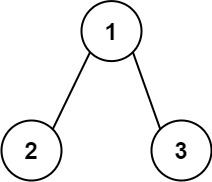
Input: root = [1,2,3]
Output: 25
Explanation:
The root-to-leaf path 1->2 represents the number 12.
The root-to-leaf path 1->3 represents the number 13.
Therefore, sum = 12 + 13 = 25.
Example 2:
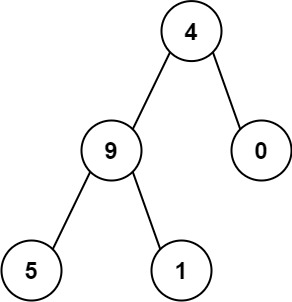
Input: root = [4,9,0,5,1]
Output: 1026
Explanation:
The root-to-leaf path 4->9->5 represents the number 495.
The root-to-leaf path 4->9->1 represents the number 491.
The root-to-leaf path 4->0 represents the number 40.
Therefore, sum = 495 + 491 + 40 = 1026.
Constraints:
-
The number of nodes in the tree is in the range
[1, 1000]. -
0 <= Node.val <= 9 -
The depth of the tree will not exceed
10.
Topics: Tree, Depth-First Search, Binary Tree
Approach
Tree DFS
Traverse the tree recursively (or with a stack). At each node, decide: what information do I need from the left/right subtrees? Process: go left → go right → combine results. Consider preorder, inorder, or postorder traversal based on when you need to process the node.
Path problems, subtree properties, tree structure manipulation.
Solutions
Solution 1: C# (Best: 100 ms)
| Metric | Value |
|---|---|
| Runtime | 100 ms |
| Memory | N/A |
| Date | 2018-08-21 |
/**
 * Definition for a binary tree node.
 * public class TreeNode {
 *     public int val;
 *     public TreeNode left;
 *     public TreeNode right;
 *     public TreeNode(int x) { val = x; }
 * }
 */
public class Solution {
    public int SumNumbers(TreeNode root) {
        if(root==null) return 0;
	int totalSum = 0;
	SumNumbers(root, 0, ref totalSum);
	return totalSum;
}

public void SumNumbers(TreeNode root, int currentSum, ref int totalSum)
{
	if (root.left == null && root.right == null)
	{
		totalSum += currentSum*10+root.val;
		return;
	}
	if(root.left!=null) SumNumbers(root.left, currentSum*10+root.val, ref totalSum);
	if(root.right!=null) SumNumbers(root.right, currentSum*10+root.val, ref totalSum);
}

}
Complexity Analysis
| Approach | Time | Space |
|---|---|---|
| Tree Traversal |
Interview Tips
- Discuss the brute force approach first, then optimize. Explain your thought process.
- Consider: "What information do I need from each subtree?" — this defines your recursive return value.