Binary Search Tree Iterator
LeetCode 173 | Difficulty: Medium
MediumProblem Description
Implement the BSTIterator class that represents an iterator over the in-order traversal of a binary search tree (BST):
-
BSTIterator(TreeNode root)Initializes an object of theBSTIteratorclass. Therootof the BST is given as part of the constructor. The pointer should be initialized to a non-existent number smaller than any element in the BST. -
boolean hasNext()Returnstrueif there exists a number in the traversal to the right of the pointer, otherwise returnsfalse. -
int next()Moves the pointer to the right, then returns the number at the pointer.
Notice that by initializing the pointer to a non-existent smallest number, the first call to next() will return the smallest element in the BST.
You may assume that next() calls will always be valid. That is, there will be at least a next number in the in-order traversal when next() is called.
Example 1:
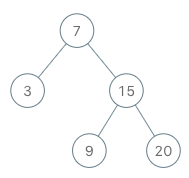
Input
["BSTIterator", "next", "next", "hasNext", "next", "hasNext", "next", "hasNext", "next", "hasNext"]
[[[7, 3, 15, null, null, 9, 20]], [], [], [], [], [], [], [], [], []]
Output
[null, 3, 7, true, 9, true, 15, true, 20, false]

Explanation
BSTIterator bSTIterator = new BSTIterator([7, 3, 15, null, null, 9, 20]);
bSTIterator.next();    // return 3
bSTIterator.next();    // return 7
bSTIterator.hasNext(); // return True
bSTIterator.next();    // return 9
bSTIterator.hasNext(); // return True
bSTIterator.next();    // return 15
bSTIterator.hasNext(); // return True
bSTIterator.next();    // return 20
bSTIterator.hasNext(); // return False
Constraints:
-
The number of nodes in the tree is in the range
[1, 10^5]. -
0 <= Node.val <= 10^6 -
At most
10^5calls will be made tohasNext, andnext.
Follow up:
- Could you implement
next()andhasNext()to run in averageO(1)time and useO(h)memory, wherehis the height of the tree?
Topics: Stack, Tree, Design, Binary Search Tree, Binary Tree, Iterator
Approach
Stack
Use a stack (LIFO) to track elements that need future processing. Process elements when a "trigger" condition is met (e.g., finding a smaller/larger element). Monotonic stack maintains elements in sorted order for next greater/smaller element problems.
Matching brackets, next greater element, evaluating expressions, backtracking history.
Design
Choose the right data structures to meet the required time complexities for each operation. Consider hash maps for O(1) access, doubly-linked lists for O(1) insertion/deletion, and combining structures for complex requirements.
Implementing a data structure or system with specific operation time requirements.
Solutions
Solution 1: C# (Best: 152 ms)
| Metric | Value |
|---|---|
| Runtime | 152 ms |
| Memory | 50.5 MB |
| Date | 2022-01-04 |
/**
 * Definition for a binary tree node.
 * public class TreeNode {
 *     public int val;
 *     public TreeNode left;
 *     public TreeNode right;
 *     public TreeNode(int val=0, TreeNode left=null, TreeNode right=null) {
 *         this.val = val;
 *         this.left = left;
 *         this.right = right;
 *     }
 * }
 */
public class BSTIterator
{
	private Stack<TreeNode> stack = new Stack<TreeNode>();
	public BSTIterator(TreeNode root)
	{
		PushAll(root);
	}

	public int Next()
	{
		TreeNode temp = stack.Pop();
		PushAll(temp.right);
		return temp.val;
	}

	public bool HasNext()
	{
		return stack.Any();
	}

	private void PushAll(TreeNode node)
	{
		while(node != null)
		{
			stack.Push(node);
			node = node.left;
		}
	}
}

/**
 * Your BSTIterator object will be instantiated and called as such:
 * BSTIterator obj = new BSTIterator(root);
 * int param_1 = obj.Next();
 * bool param_2 = obj.HasNext();
 */
📜 1 more C# submission(s)
Submission (2022-01-04) — 221 ms, 48.9 MB
/**
 * Definition for a binary tree node.
 * public class TreeNode {
 *     public int val;
 *     public TreeNode left;
 *     public TreeNode right;
 *     public TreeNode(int val=0, TreeNode left=null, TreeNode right=null) {
 *         this.val = val;
 *         this.left = left;
 *         this.right = right;
 *     }
 * }
 */
public class BSTIterator
{
	private TreeNode cur;
	public BSTIterator(TreeNode root)
	{
		cur = root;
	}

	public bool HasNext()
	{
		return cur != null;
	}

	public int Next()
	{
		int r = 0;
		while (cur != null)
		{
			if (cur.left == null)
			{
				r = cur.val;
				cur = cur.right;
				// Got the node, break loop
				break;
			}
			else
			{
				TreeNode node = cur.left;
				while (node.right != null && node.right != cur)
				{
					node = node.right;
				}
				if (node.right == null)
				{
					node.right = cur;
					cur = cur.left;
				}
				else
				{
					node.right = null;
					r = cur.val;
					cur = cur.right;
					// Got the node, break loop
					break;
				}
			}
		}
		return r;
	}
}

/**
 * Your BSTIterator object will be instantiated and called as such:
 * BSTIterator obj = new BSTIterator(root);
 * int param_1 = obj.Next();
 * bool param_2 = obj.HasNext();
 */
Complexity Analysis
| Approach | Time | Space |
|---|---|---|
| Stack |
Interview Tips
- Discuss the brute force approach first, then optimize. Explain your thought process.
- Consider: "What information do I need from each subtree?" — this defines your recursive return value.
- Think about what triggers a pop: is it finding a match, or finding a smaller/larger element?
- Clarify the expected time complexity for each operation before choosing data structures.