Largest Rectangle in Histogram
LeetCode 84 | Difficulty: Hard
HardProblem Description
Given an array of integers heights representing the histogram's bar height where the width of each bar is 1, return the area of the largest rectangle in the histogram.
Example 1:
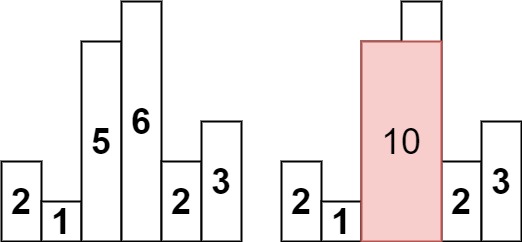
Input: heights = [2,1,5,6,2,3]
Output: 10
Explanation: The above is a histogram where width of each bar is 1.
The largest rectangle is shown in the red area, which has an area = 10 units.
Example 2:
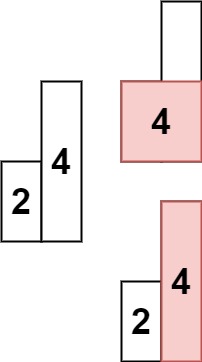
Input: heights = [2,4]
Output: 4
Constraints:
-
1 <= heights.length <= 10^5 -
0 <= heights[i] <= 10^4
Topics: Array, Stack, Monotonic Stack
Approach
Stack
Use a stack (LIFO) to track elements that need future processing. Process elements when a "trigger" condition is met (e.g., finding a smaller/larger element). Monotonic stack maintains elements in sorted order for next greater/smaller element problems.
When to use
Matching brackets, next greater element, evaluating expressions, backtracking history.
Solutions
Solution 1: C# (Best: 100 ms)
| Metric | Value |
|---|---|
| Runtime | 100 ms |
| Memory | 26.7 MB |
| Date | 2020-03-07 |
Solution
public class Solution {
    public int LargestRectangleArea(int[] heights) {
        int len = heights.Length;
	Stack<int> s = new Stack<int>();
	int maxArea = 0;
	for (int i = 0; i <= len; i++)
	{
		int h = (i == len ? 0 : heights[i]);
		if(s.Count == 0 || h >= heights[s.Peek()]){
			s.Push(i);
		}
		else
		{
			int tp = s.Pop();
			maxArea = Math.Max(maxArea, heights[tp] * (s.Count==0 ? i : i-1-s.Peek()));
			i--;
		}
	}
	return maxArea;
    }
}
📜 1 more C# submission(s)
Submission (2022-01-20) — 383 ms, 48.3 MB
public class Solution {
    public int LargestRectangleArea(int[] heights) {
    int len = heights.Length;
	Stack<int> s = new Stack<int>();
	s.Push(-1);
	int maxArea = 0;
	for(int i=0;i<len;i++)
	{
		if(s.Peek() == -1 || heights[i]>=heights[s.Peek()])
		{
			s.Push(i);
		}
		else
		{
			while(s.Peek() != -1 && heights[s.Peek()]>heights[i])
			{
				var top = s.Pop();
				maxArea = Math.Max(maxArea, heights[top] * (i-s.Peek()-1));
			}
			s.Push(i);
		}
	}
	while(s.Peek() != -1)
	{
		var top = s.Pop();
		maxArea = Math.Max(maxArea, heights[top]*(len-s.Peek()-1));
	}
	return maxArea;
    }
}
Complexity Analysis
| Approach | Time | Space |
|---|---|---|
| Stack |
Interview Tips
Key Points
- Break the problem into smaller subproblems. Communicate your approach before coding.
- Think about what triggers a pop: is it finding a match, or finding a smaller/larger element?